Clothes for Survival Swimming and Rescue Training
We are often asked why we swim in clothes and what kit is best for proper training. The tips in this section are designed to help you find the right outfit.
Training Realism
Clothes add greater realism to your swimming and lifesaving practice, while building up your strength and confidence. This also makes your lessons more interesting and a lot more fun. You should be somewhat comfortable with swimming in clothes because you will adjust the intensity of your exercise with the amount of clothing you wear in the water.
Swim coaches like to talk about how swimming is harder in clothes, due to an increase in drag. Swimmers reduce the impact of increased drag with better skills or with more muscle strength. They may find it difficult to apply more muscle strength to the water if they don't do it the right way. Swimming in clothes forces you to do a skill right or you go nowhere.
👉 Remember, swimming in clothes may be tough, but this skill can save lives! 👈
Learn to Swim in Clothes
Swimming in clothes may be an obvious training element, but is often ignored by many swimming clubs, leaving members unprepared in emergencies. It is an essential survival skill.
This is usually the most popular session among advanced swim teams, intended for competent swimmers. Lifeguard teams learn to swim well in their uniforms and use clothes as rescue and towing aids. If regularly practised it combines strength and stamina with variety and fun.
Teachers lead by example and demonstrate how different clothes influence your swimming ability.
You'll learn how heavy wet clothes really get
and how that affects your swimming skills, a key to aquatic survival.
The more clothing layers you wear in the water, the harder your training gets.
This builds strength and prepares you for an actual emergency situation.
Water Sports
Whether you’re sailing, kayaking, canoeing, kitesurfing or adventure hiking, there’s always a good chance you’ll end up in the water unexpectedly. Be it sailing, canoeing, kite surfing or adventure hiking, you wouldn't do it only in swim briefs or bikini. Swimming in clothes is an essential skill for most water sports because a good soaking is part of the experience and appeal.
You want to be prepared for when your boat capsizes, or you fall in, or you go for a spontaneous swim, voluntarily or not. While safety precautions should be taken, the nature of adventure sports recommends that you wear attire that reduces the possibility of mishap.
Swimming fully clothed builds the confidence, control and skills you need when the unexpected happens. The clothes you wear for water sports can feel very different once they’re soaked, affecting your movement, buoyancy and confidence in the water.
Training in your usual water sports clothes helps you understand how your body and kit respond when wet,
so you’re better prepared to stay calm, swim effectively and get yourself to safety.
Because when adventure takes you into the water, you need to be ready to swim your way out.
Safe Clothing Colours
Light blue swim clothes make you almost invisible in the pool. The contrast is too low. Lifeguards may not see you and other swimmers may bump into you.
Consider swimwear in bright colours so you can be seen. Most swimwear on the market is black or blue. A bright red or yellow anorak worn on top can cheer it up and provide a stronger workout as you have to swim against more resistance.
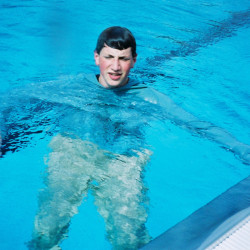
Light blue swim clothes make you almost invisible in a pool.
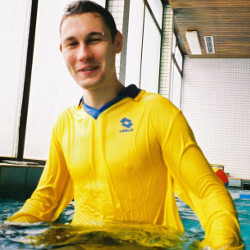
Be seen in bright colours.
Are Clothes Heavy in Water?
Not really. Clothes weigh very little in water. Throw an item of clothing into a swimming pool and notice how slowly it sinks, if at all. Pull it out of the pool and it gets heavy with all the water it soaked up. Cotton and fleece soaks up more than unlined nylon rainwear.
Don't Confuse Slow Down with Weigh Down
Many people who haven't tried swimming fully clothed, wrongly think they get pulled down by the weight of wet clothes. But that only happens when you come OUT of the water.
When you wear your clothes in the water, they just float around you. The soaked up water only displaces water which would have been there anyway. Water weighs nothing in water, so they only weigh you down by their DRY weight, minus the weight of water displaced by the fabric.
However, the water that's soaked up by the fabric, or collects inside your clothes, will slow down your movements.
This makes it harder on your muscles to move you forward and thus improves training results.
Weigh and Measure Wet and Dry
This experiment will show you how clothes affect your movements and weight in the water. Although your clothes won't pull you down, they will resist your movements and give you a hard workout. One litre of water weighs one kilogram.
- First weigh yourself without any clothes on. Write it down.
- Next get fully dressed in jeans or sweatpants, T-shirt, a hooded sweatshirt,
and possibly a pair of lightweight sports shoes and socks.
The difference in weight with clothes on should be 2 or 3 kg. Write it down.
- Now hop into the water.
Stay in for a while to make sure you get everything fully soaked,
so we can check the weight difference.
Cotton garments soak up a lot of water.
- As soon as you come out of the water, weigh yourself again while still shiny wet.
The difference in weight compared to wearing no clothes should be about 4 to 8 kg, depending on your size.
So the water in your clothes weighs between 2 and 5 kg, about 2 and 5 litres. About half of it runs off in a few minutes.
- Now that you have an idea how much weight is involved you can start your power training.
Do a few push-ups or sit-ups on the pool side. Compare the effort in dry clothes and wet clothes.
Next climb out and jump in as often as you can in one minute. This may sound trivial, but you'll soon find out that it can be quite tough.